How to Find the Right HS or HTS code
Build a defensible HS or HTS classification process with product evidence, legal notes, tariff-version checks and ruling guidance for U.S. and UK trade.
By Traddal team, , 24 min read
The right HS or HTS code is the code supported by your product facts, tariff text and legal notes on the declaration date, not the closest description in a supplier spreadsheet. To find it, collect a complete product record, identify the destination’s tariff system, test candidate headings under the legal rules, then preserve the evidence behind the choice.
How do you find the right HS or HTS code without copying an unreliable code from a marketplace listing, supplier invoice or old shipment? By the end of this guide, you will have a repeatable seven-step classification workflow and an audit record your customs, operations and merchant teams can use. Start with the product itself: its materials, construction, use, presentation and origin data.
Rules as of November 17, 2026.
An HS code is the six-digit international product classification used as the common starting point for customs tariffs and trade statistics worldwide. Countries then extend that common six-digit classification into their own tariff systems, including the U.S. HTSUS and UK commodity codes.

What a defensible classification process does
- Start with product evidence, because a marketing name rarely describes the characteristics customs classification depends on.
- Use the tariff schedule that applies in the destination country on the declaration date, not a permanent code copied from an overseas supplier.
- For U.S. imports, apply the General Rules of Interpretation, legal notes and heading text before relying on search results or prior rulings.
- Treat the first six digits as the international HS level, then validate the national code required for the import or export declaration.
- Store the facts, alternative headings and legal rationale with the product record so the code can be reviewed when the product or tariff changes.
Step 1: Build a product record before searching#
A product record is the evidence pack used to classify one specific good, in its imported condition. Build the product record before opening a tariff search tool because customs nomenclature distinguishes goods by composition, function, construction, manufacture, packaging and presentation, not by the product title used in an online catalog.
Action: Ask the product owner, manufacturer or merchant for the facts that describe the article as it will cross the border. Do not accept “wireless accessory,” “beauty item,” “premium clothing,” or “kitchen gadget” as a complete description. Those phrases are commercial labels. They usually omit the characteristics that decide classification.
The UK Trade Tariff tells users to gather at least five facts before choosing a commodity code: product type, use, materials, production method and packaging. HMRC’s guidance is useful beyond UK imports because it describes the core information a classifier needs in any tariff system.
Build one structured product record for each distinct SKU or product variant. If a style differs in fiber content, component materials, dimensions, power source, intended use, form factor or retail presentation, it may need separate review. A small product change can move the classification analysis even where the merchant-facing name stays the same.
At minimum, record:
A plain-language product description that says what the item physically is.
The technical or generic product name used by the manufacturer.
Material composition, ideally with percentages where relevant.
The primary function and intended use.
How the good is made or assembled.
Whether it is complete, unfinished, unassembled or disassembled.
Dimensions, capacity, weight, voltage, connectivity or other technical specifications where relevant.
The contents of sets, kits, multipacks and retail packs.
Product photographs, manuals, specification sheets and packaging images.
Manufacturer name, supplier part number and country-of-origin information.
For U.S. transactions, CBP advises importers to be prepared with country of origin and manufacturer details, composition, intended use, and pricing or payment information. Pricing does not decide the tariff code in the same way composition or function can, but transaction information matters to a complete import review.
A useful operational rule is this: if a reviewer cannot tell the difference between two plausible tariff headings from the product record, the product record is incomplete. Request a material declaration, bill of materials, technical drawing, product manual, sample or manufacturer confirmation before assigning the code at scale.
What to collect from merchants and suppliers#
For a courier, freight consolidator, postal operator or 3PL, classification quality begins upstream. A shipper cannot create a valid declaration from “gift,” “sample,” “parts,” “accessories,” or a product listing title alone. Your merchant onboarding form, API schema or spreadsheet template should make the required product facts explicit.
Use separate fields rather than one long description field. “Stainless steel insulated drink bottle with plastic screw cap, 750 ml” can be searched and reviewed. “Bottle” cannot. “Knitted women’s top, 92% cotton and 8% elastane” gives a reviewer a starting point. “Fashion top” does not.
The World Customs Organization says its Explanatory Notes identify principal inclusions and exclusions, technical descriptions, properties, production methods and uses. The WCO’s description of the Notes explains why the evidence pack needs these details before a code search begins.
Where product information is missing, use a controlled status such as “classification pending supplier evidence.” Do not fill the gap by selecting the first plausible code. A weak initial decision can spread through listings, invoices, labels, manifests and customs declarations faster than the team can correct it.
Why it matters: Classification is not a keyword-matching exercise. A keyword search can help you find candidate headings, but it cannot prove that a heading applies. The proof comes from the product facts, the legal wording and the notes that include or exclude the item.
Done looks like: Each SKU has a structured description, composition, function, manufacturing information, presentation details and supporting files. The product record is specific enough that a second reviewer could understand what is being classified without opening a consumer-facing product page.
Classification intake checklist
0/8Step 2: Choose the tariff system and date that apply#
The applicable tariff system is set by the movement and declaration, not by where a supplier found a code. Start with the import destination, determine whether you need the international HS level or a national extension, and use the tariff version effective on the date of import, export or declaration.
Action: Identify what customs outcome you are trying to support. Are you preparing a U.S. import entry, a U.S. export filing, a UK import declaration, a UK export declaration, a catalogue-level HS6 field, or an internal estimate before the shipment is booked? The answer determines both the code format and the source you must consult.
The Harmonized System contains more than 5,000 commodity groups identified at six digits. The first six digits are the internationally harmonized level. The WCO explains the HS structure, but that does not mean six digits are always enough for a customs declaration.
For U.S. imports, use the Harmonized Tariff Schedule of the United States, or HTSUS. The HTSUS sets tariff rates and statistical categories for imported merchandise. As of November 17, 2026, the current edition is 2026 HTS Revision 23, published by the U.S. International Trade Commission on November 10, 2026.
For U.S. exports, use Schedule B where an export classification is required. A Schedule B code is a 10-digit export code and may differ from a 10-digit HTSUS import code, even though the systems align through the first six digits. The U.S. Census Bureau confirms that distinction. Do not file a U.S. export with an HTSUS number merely because the first six digits look familiar.
For UK trade, the first six digits are internationally shared, but the UK tariff must be checked for the declaration. HMRC says an overseas supplier’s code should not be copied unchanged into a UK declaration. UK commodity-code guidance also explains that import commodity codes generally require 10 digits and export commodity codes generally require 8 digits.
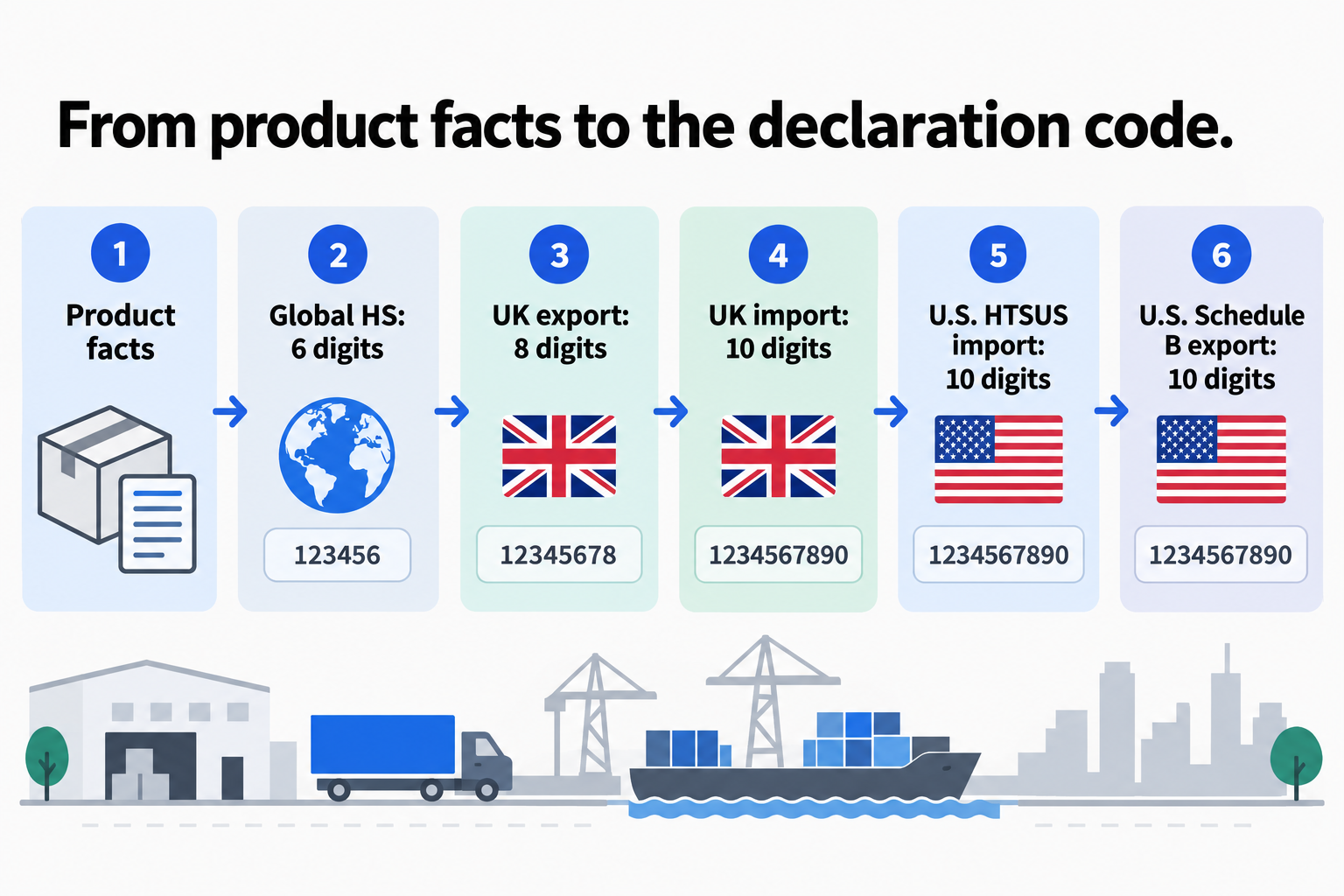
The comparison below shows why a six-digit product code is only the beginning of the process for many operational uses.
Source: World Customs Organization, n.d.; HM Revenue & Customs, 20 December 2022; U.S. Census Bureau, n.d.
The data
| Classification system | Digits required |
|---|---|
| Global HS | 6 |
| UK export commodity code | 8 |
| U.S. HTSUS import code | 10 |
| U.S. Schedule B export code | 10 |
| UK import commodity code | 10 |
The takeaway is simple: preserve the HS6 where it is useful for global catalog governance, but validate the destination-specific extension before filing or pricing a shipment.
Control tariff versions, not just code values#
Codes are versioned legal data. A product can remain unchanged while the tariff schedule changes around it. Record the tariff edition, revision or effective date used for every decision. That record becomes important when a broker, customer, customs authority or internal auditor asks why a code was selected.
HS 2022 is the current international baseline until HS 2028 takes effect. The WCO says HS 2028 enters into force on January 1, 2028 and brings 299 sets of amendments across 1,229 headings and 5,852 six-digit subheadings. The WCO’s HS 2028 amendment notice is a reminder that an HS6 value should never be treated as a permanent product attribute.
This is where a governed catalogue beats an unmanaged spreadsheet. Store the classification decision with its effective date, tariff source, reviewer and evidence. Set review triggers for tariff revisions, supplier changes, product redesigns and new destination markets.
If you need one workspace for U.S., UK and global HS6 classification records, Traddal’s HS code classification supports those coverage levels. The operational need is not just finding a number once. It is keeping the selected number tied to the correct product and destination context.
Why it matters: A valid global HS6 can still be incomplete for a national import declaration. A code that was correct under one tariff edition can also become stale after a revision.
Done looks like: The product record names the destination, movement type, tariff source, code length, tariff version and effective date. The team can explain whether the stored code is HS6, HTSUS, Schedule B, a UK import commodity code or a UK export commodity code.
| Global product catalogue | HS | 6 | International HS heading and subheading |
| UK export declaration | UK commodity code | 8 | UK export commodity code effective on declaration date |
| U.S. import declaration | HTSUS | 10 | Current HTSUS wording, legal notes and tariff treatment |
| U.S. export filing | Schedule B | 10 | Current Schedule B description and export requirements |
| UK import declaration | UK commodity code | 10 | UK tariff measures effective on declaration date |
World Customs Organization, n.d.; U.S. Census Bureau, n.d.; HM Revenue & Customs, 20 December 2022.
Step 3: Search broadly, then read the legal text#
Search terms are useful for finding possible headings, but the legal text decides the classification. Begin with technical nouns, materials and functions, then read the heading wording and relevant legal notes in the tariff version that applies. Treat search results, supplier codes and product-page labels as leads, not conclusions.
Action: Turn the product record into several search phrases. Use the object’s technical noun, its primary function, material, manufacturing form and known synonyms. Search the tariff index, official tariff tool and, where available, explanatory material. Do not rely on a brand name or the phrase used in the online listing.
The U.S. Census Bureau recommends searching Schedule B descriptions and its six-digit alphabetical index using alternative product terminology. Census guidance on Schedule B searching supports a better habit for any nomenclature search: look for the technical object, not the marketing description.
For example, a search for “smart home accessory” is too broad to prove anything. Search terms might instead describe the physical good, such as a sensor, switch, relay, housing, cable, charging device, controller or apparatus. The final classification still depends on the complete facts. The search only gets you to headings worth reading.
For U.S. imports, start with the actual heading wording and relevant legal notes. The U.S. International Trade Commission’s General Rules of Interpretation state that section, chapter and subchapter titles are provided for ease of reference. They are not the legal basis of classification.
That distinction prevents a common error. A chapter title can look like a perfect category for the item, while a chapter note directs the item elsewhere. A heading label can sound broad enough to include the product, while the legal wording or exclusion note does not.
Read from the top down#
Read the section and chapter structure for orientation, then move through the legal hierarchy:
Review relevant section and chapter notes.
Read the heading text.
Read the subheading text.
Check any notes that apply at the subheading level.
Read the relevant Explanatory Notes where available.
Test whether the article meets the wording in its imported condition.
The WCO Explanatory Notes comprise five volumes plus amending supplements. The WCO describes them as the official interpretation of the HS at the international level, while also making clear that they are not themselves part of the HS Convention. The WCO’s Explanatory Notes page makes them valuable interpretive evidence, especially when headings contain technical distinctions or exclusions.
Use the Notes to confirm principal inclusions, exclusions, technical characteristics, production methods and uses. Do not quote a short search snippet as if it were the full interpretation. Read enough surrounding text to understand whether the product falls inside or outside the described group.
For UK classification, use the official Trade Tariff for the date of movement. The code can determine Customs Duty, import VAT, taxes, possible preferential treatment and whether measures such as licences, anti-dumping duties, safeguards or tariff quotas apply. HMRC’s commodity-code guidance explains why a code search must end with a check of destination-specific measures.
Why it matters: Search algorithms rank text matches. Customs classification applies legal language to goods. The two processes are related, but they are not interchangeable.
Done looks like: The product record lists two or more plausible candidate headings where appropriate, the exact legal wording reviewed, the relevant notes and the reason each rejected heading did not apply. A reviewer can reproduce the search without guessing which tariff version was used.
Step 4: Apply the General Rules of Interpretation#
The General Rules of Interpretation, often called the GRIs, provide the legal sequence for choosing between headings and subheadings in the U.S. HTSUS. Apply GRI 1 first, then move to later rules only when the product cannot be classified under the earlier rule. The rules are not a menu of optional arguments.
Action: Document the rule that resolves the classification. If heading text and legal notes directly describe the imported product, classify under GRI 1. Do not jump to “essential character” because it seems commercially intuitive. Essential character becomes relevant only in the circumstances addressed by the later rules.
The U.S. tariff’s General Rules of Interpretation say that classification is determined according to the terms of the headings and any relevant section or chapter notes. The HTSUS GRI text places GRI 1 first for a reason. It is the starting point, not a preliminary suggestion.
GRI 2(a) covers incomplete, unfinished, unassembled or disassembled articles that have the essential character of the complete or finished article. This matters in cross-border operations because a shipment may be packed flat, sent in components or imported before final assembly. The record must explain why the imported goods do, or do not, have the essential character of the completed article.
GRI 3 applies where goods are prima facie classifiable under two or more headings. The sequence is specific: assess whether one heading provides the most specific description, then consider essential character where appropriate, then use the heading that occurs last in numerical order if the earlier tests do not resolve the issue. Do not cite only one phrase from GRI 3 while skipping the rest of its sequence.
Use a comparison memo for close calls#
Where more than one heading is plausible, create a short comparison memo. It does not need to be formal legal writing. It should be precise enough to show the decision path.
For each candidate heading, record:
The exact heading and subheading text.
The product facts that support the heading.
The facts that conflict with it.
Relevant section, chapter or subheading notes.
Relevant Explanatory Note inclusions or exclusions.
The GRI applied.
The conclusion and reviewer.
This record is especially important for composite goods, retail sets, unassembled articles and products with multiple functions. These are not categories to solve by copying a code from a similar product. The details of the imported article control the outcome.
Do not confuse classification with an overall customs decision. An HTSUS classification identifies the tariff provision, but the final charges on a future shipment can still depend on origin, valuation, applicable measures and the date of entry. CBP’s Binding Ruling Program states that tariff classifications are binding, while duty rates are not. That is an important distinction for sellers promising a delivered price.
Why it matters: The GRI sequence turns a plausible answer into a defensible one. It also shows your team when a product needs specialist review rather than a quick catalogue assignment.
Done looks like: The classification record names the applicable GRI and explains how the product meets the selected heading and subheading. If the product is incomplete, composite, packaged as a set or capable of multiple uses, the reasoning addresses those facts directly.

Step 5: Validate the national code and customs measures#
A six-digit HS result is not the end of the task when the shipment needs a national customs declaration. Validate the national extension, applicable measures and declaration-date treatment in the destination tariff. The same HS6 can lead to different national reporting requirements, tariff lines or regulatory checks across importing markets.
Action: Once the HS heading and subheading are supported, move into the destination’s national tariff schedule. Select the full code required for the movement, then review the measures attached to that code for the date of declaration.
For a U.S. import, that means the current HTSUS provision and any relevant tariff treatment indicated in the schedule. For a U.S. export, it means validating the appropriate 10-digit Schedule B number rather than reusing the HTSUS import classification. For UK trade, it means checking the relevant UK import or export commodity code and associated measures.
HMRC states that the commodity code can determine Customs Duty, import VAT, taxes and potential preferential treatment. It may also show licences, anti-dumping duties, safeguards and tariff quotas. The official UK guidance is clear that classification affects more than the basic duty line.
This is also the point where you separate classification from landed-cost calculation. The code is a required input, but it is not the entire calculation. Origin, customs value, Incoterms, treatment under applicable measures and the declaration date can affect what is charged.
Worked workflow: a shipment classification record#
Consider a hypothetical merchant shipment valued at US$2,500, made by a manufacturer in South Korea and sent to the United Kingdom. The shipment contains one SKU, and the merchant provides a technical description, material breakdown, product photographs, packaging details and a manufacturer specification sheet.
The operations team does not use the US$2,500 selling value to choose the commodity code. The team first identifies the goods, searches candidate headings, reads the UK tariff wording and notes, and selects the supported 10-digit UK import commodity code for the declaration date.
At the classification stage, no party has paid an import charge. Classification is data preparation, not payment. Once the code has been selected, the UK tariff review identifies the applicable duty, VAT, taxes and any other measures for that commodity code and date. If the seller offers delivered-duty-paid pricing, the seller needs those later landed-cost inputs before quoting the customer. If the buyer is responsible for import charges, the buyer still needs accurate classification to avoid an unexpected assessment.
The practical lesson is that a shipment value is not a shortcut to a tariff code, and a tariff code alone is not a duty quote. Use a code first, then calculate charges using the facts that customs valuation and destination measures require.
For U.S. and UK lanes, Traddal’s landed cost and duty calculation tools can help turn a supported classification into an operational estimate. The estimate must still use the actual shipment facts and destination treatment.
Why it matters: A correct HS6 with an incomplete national code can fail a declaration. A technically correct national code can still produce an inaccurate price if origin, value or applicable measures are missing.
Done looks like: The final record includes the national code needed for the movement, the tariff schedule checked, the effective date, the destination measures reviewed and a clear handoff to the duty, VAT and pricing process.
Step 6: Check rulings and escalate uncertain classifications#
Prior rulings can improve a classification review, but they do not replace an analysis of the goods in front of you. Research rulings for similar facts, check whether they remain valid, and seek an advance decision before clearance when the classification risk, volume or commercial consequence justifies formal confirmation.
Action: Use rulings after you have built the product record and analyzed the tariff text. A ruling is most useful when it concerns a product with genuinely similar materials, construction, function and presentation. A shared product name or category is not enough.
In the United States, CBP rulings can be researched through CROSS. Its collection spans 1989 to the present, but CBP warns that not all rulings issued since 1989 are included. Treat CROSS as a research source, not as a complete or permanent database of controlling answers.
When using a prior ruling, check the ruling date, factual description, tariff language, later modifications, revocations and the tariff version. A ruling on a different construction, packaging or use may not support your product. A ruling issued under earlier tariff language may need fresh analysis.
CBP’s Binding Ruling Program provides binding pre-entry classification decisions. CBP’s program guidance says the classification decision is binding, but duty rates are not. Under 19 CFR Part 177, rulings are generally prospective rather than decisions on matters already under consideration by a CBP field office.
For Great Britain, an Advance Tariff Ruling application must be submitted before all customs procedures are completed. HMRC’s ATR guidance means it cannot be used as a retrospective route to fix a classification after clearance. HMRC asks for detailed product information and, where appropriate, brochures, manuals, photographs and samples.
HMRC says it aims to reply to an Advance Tariff Ruling application in 30 to 120 days, and a legally binding commodity-code decision is generally valid for three years from its stated start date. HMRC’s ruling guidance should shape your planning. Do not wait until a high-volume shipment is at the airport or port to identify a classification issue that needs a ruling.
Why it matters: A formal ruling can reduce uncertainty for recurring, high-value or legally ambiguous goods. It cannot repair a missing product record or replace a review of whether the ruling facts match your shipment.
Done looks like: The file records relevant rulings considered, their factual fit, their current status and the reason a formal ruling was or was not requested. If a ruling application is needed, the evidence pack is ready before customs clearance.
Step 7: Publish the code with controls and an audit trail#
A classification decision becomes operational only when it reaches the catalogue, invoice, label, manifest and declaration workflow with the right controls. Publish the approved code alongside its evidence and effective date, then monitor the product and tariff changes that could make the decision stale or unsuitable for another market.
Action: Treat the classification record as controlled master data. Do not store only the final code. Store the evidence, tariff source, version, reviewer, decision date, candidate headings and rationale. That record is what makes later review possible.
A defensible record should preserve at least seven fields: product description, composition, function, manufacturing method, packaging or presentation, candidate headings considered and legal rationale. Those fields reflect the characteristics used in official tariff tools and ruling applications. The supporting evidence should remain accessible even if the supplier changes product pages or retires a SKU.
Create a practical approval model:
Use a controlled status for proposed, approved, expired and under-review codes.
Restrict manual edits to approved tariff fields.
Require a reason and reviewer when a code changes.
Trigger review when materials, function, manufacturing, packaging or supplier change.
Trigger review when a new national destination is added.
Trigger review when tariff editions change.
Flag generic descriptions before a label, manifest or declaration is generated.
A product catalogue should also distinguish global HS6 from market-specific codes. One SKU can have a supported global HS6 record, a U.S. HTSUS import code, a U.S. Schedule B export code and UK commodity-code records. Those fields should not overwrite one another.
Classification also needs to flow into shipping data without losing the product description. A customs declaration, commercial invoice and manifest should describe goods accurately enough to support the code. Generic lines such as “merchandise” or “accessories” weaken the evidence trail and make customs queries more likely.
Use a controlled invoice workflow when product data is ready. A pro forma invoice generator can help teams format shipment documentation, but it cannot make an incomplete description or unverified code defensible. The product record must come first.
If you collect import charges from buyers, make sure the code and landed-cost decision reach the payment workflow before dispatch. Duty collection and payment portals are operationally useful only when the customs inputs behind the amount are correct.
Why it matters: Classification errors often appear downstream as returned parcels, clearance holds, under-collected charges, customer disputes or post-entry corrections. Strong catalogue governance catches errors before data reaches the carrier or customs filing.
Done looks like: Every live code is traceable to a SKU, destination, tariff version, evidence pack and reviewer. Operations teams can identify which catalog entries are affected by a tariff update or product change without searching through old emails and spreadsheets.
Common mistakes when finding HS and HTS codes#
Most classification errors begin with a shortcut: copying an old code, trusting a product title or treating a search result as the answer. Preventing those mistakes requires disciplined inputs, legal reading and version control. The goal is not to make every SKU a legal research project, but to know when ordinary product data is enough and when escalation is needed.
Copying a supplier’s code unchanged. The supplier may have classified for a different destination, tariff edition or export requirement. The first six digits may align internationally, but national extensions and tariff measures vary. Validate the code in the importing country’s tariff.
Using a marketplace category or marketing title. “Phone accessory,” “outdoor equipment,” “beauty product” and “fashion item” are commercial groupings. They are too broad to establish a heading. Ask what the product is made of, what it does and how it is presented.
Starting with duty rate instead of classification. A low duty rate does not make a heading correct. Select the supported code first. Then determine the charges using origin, value, applicable measures and the declaration date.
Using an HTSUS code for a U.S. export. HTSUS is the U.S. import schedule. Schedule B is the U.S. export classification system. The first six digits can align, but the 10-digit codes can differ.
Ignoring notes and exclusions. Heading titles and search results are only part of the analysis. Read section, chapter and subheading notes, then check Explanatory Notes where they help explain international HS scope.
Treating every item in a kit or multipack as a single simple product. Sets, combinations, composite goods and unassembled articles require a fact-specific analysis under the General Rules of Interpretation. Record the contents and imported presentation.
Failing to preserve rejected headings. A code without rationale is hard to defend and expensive to revisit. Keep a short explanation of why the selected heading fits and why close alternatives do not.
Leaving old codes in production after changes. HS 2028 takes effect on January 1, 2028. Product changes and tariff revisions should trigger review before affected codes move into declarations, pricing or labels.
Sources#
The sources below are the official or primary references used for the legal framework, tariff-system distinctions and ruling processes in this guide. Consult the live tariff tool and current legal text for the actual declaration date because tariff schedules, national measures and customs guidance can change after publication.
World Customs Organization, “What is the Harmonized System?”, n.d.
World Customs Organization, “Amendments effective from 1 January 2028”, January 2026
United States International Trade Commission, “General Rules of Interpretation”, 2026
GOV.UK, “Trade Tariff: look up commodity codes, duty and VAT rates”, n.d.
U.S. Customs and Border Protection, “Tips for New Importers and Exporters”, 2026
U.S. Customs and Border Protection, “Binding Ruling Program”, 2026
U.S. Customs and Border Protection, “CROSS, Access to rulings issued by Customs”, July 17, 2026
Electronic Code of Federal Regulations, “19 CFR 177.0, Scope”, current as of November 17, 2026
HM Revenue & Customs, “Apply for an Advance Tariff Ruling”, June 2, 2026
FAQ#
The questions below address the decisions operations teams make after the first code search: which code format to use, whether a supplier code is reliable, how rulings work and what information must be retained. The answer to each question depends on the goods, destination and tariff schedule effective for the declaration date.
HS and HTS code questions
How do I find the correct HS code for a product?
Start with a complete product record: technical description, composition, function, manufacturing method and packaging. Search for candidate headings using technical terms, then confirm the result against the heading wording, legal notes and relevant Explanatory Notes. The first six digits are the international HS level.
Is an HS code the same as an HTS code?
No. An HS code is the internationally harmonized classification at six digits. An HTSUS code is a U.S. import classification that extends the HS system to 10 digits. Use the code required by the movement and destination, not whichever format a supplier provides.
Can I use my supplier’s HS code for a UK import?
Not without checking it. HMRC says only the first six digits are used worldwide, so an overseas supplier’s code must be validated against the UK tariff. UK imports generally require a 10-digit commodity code and UK exports generally require an 8-digit code.
Should I use HTSUS or Schedule B for a U.S. shipment?
Use HTSUS for U.S. imports and Schedule B for U.S. exports. Both systems can align through the first six digits, but their 10-digit codes can differ. Do not use an HTSUS import code as an automatic substitute for a Schedule B export code.
What information do I need before classifying a product?
At minimum, collect the product type, intended use, materials, production method and packaging. For a fuller U.S. import review, CBP also recommends being prepared with country of origin and manufacturer information, composition, intended use, and pricing or payment information.
Can a CBP binding ruling tell me what duty I will pay?
A CBP binding ruling can provide a binding tariff classification decision before entry, but CBP states that duty rates are not binding. The final charges can depend on the tariff treatment, origin, customs value, applicable measures and date of entry.
When should I apply for a UK Advance Tariff Ruling?
Apply before all customs procedures are completed. HMRC says Advance Tariff Rulings cannot be used to obtain a retrospective classification decision after clearance. Prepare detailed goods information and supporting brochures, manuals, photographs or samples where appropriate.