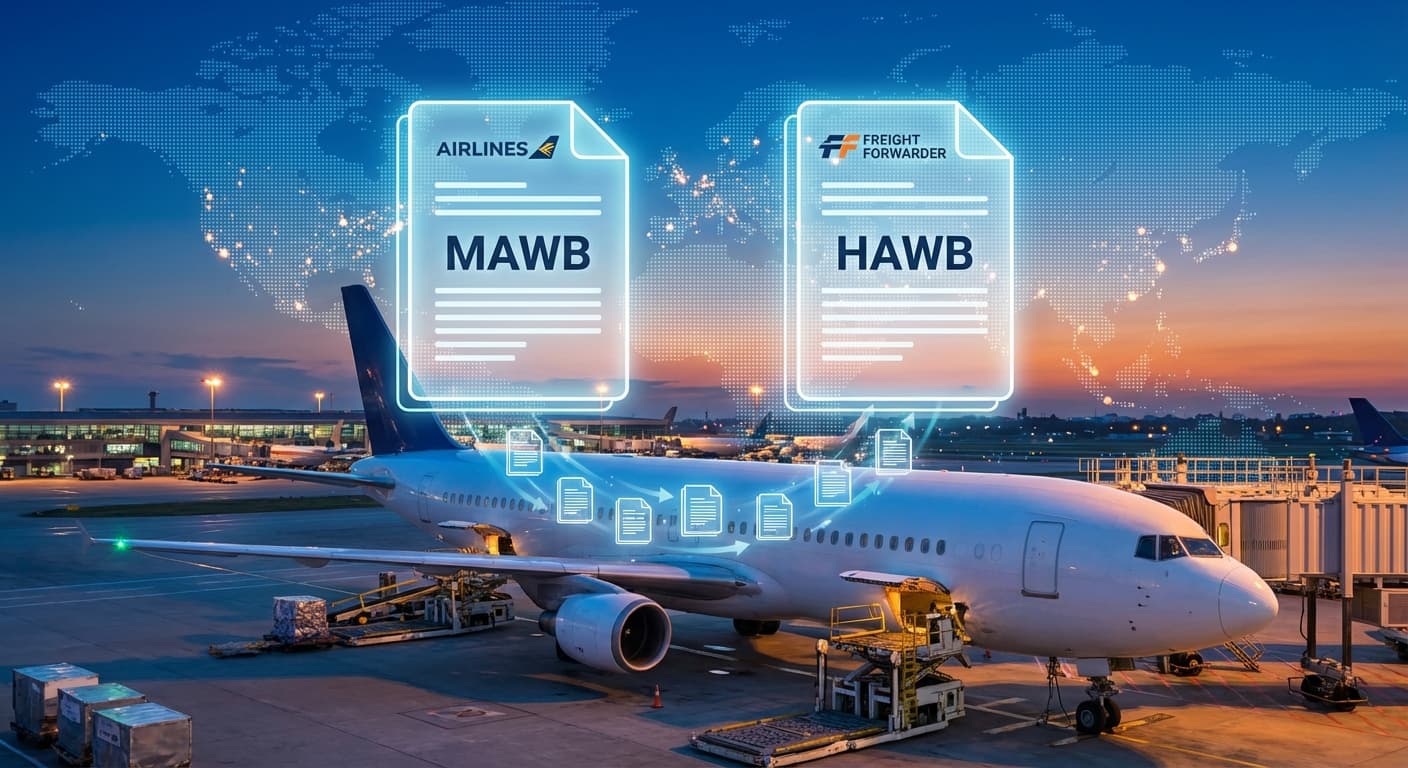
MAWB vs HAWB: A Deep Dive into Air Freight Documentation
The difference between a Master Air Waybill (MAWB) and a House Air Waybill (HAWB) is defined by the issuing party and the contractual relationship. A MAWB is issued by an airline to a freight forwarder for a consolidated shipment. A HAWB is issued by the forwarder to the actual shipper for their specific goods. While the MAWB governs the airline-to-forwarder relationship, the HAWB is the primary document used for individual customs clearance and cargo tracking.
For businesses involved in international trade, air freight is the most efficient method for transporting high-value or time-sensitive goods. However, the speed of air transit requires meticulous documentation to ensure cargo moves through customs without delay.
The two most essential documents in this process are the Master Air Waybill (MAWB) and the House Air Waybill (HAWB). This guide breaks down their functions, legal standing, and how they interact within the global supply chain.
1. What is an Air Waybill (AWB)?
An Air Waybill is a non-negotiable transport document that serves as a formal agreement between the shipper and the carrier. Unlike an Ocean Bill of Lading, it does not act as a document of title or proof of ownership. Instead, its primary roles include:
- Contract of Carriage: It outlines the terms and conditions under which the carrier moves the goods.
- Receipt of Cargo: It acts as confirmation that the airline or agent has received the goods in acceptable condition.
- Customs Reference: It provides the necessary data for authorities to assess duties, taxes, and security risks.
Every air shipment must be accompanied by an AWB. Whether it is a Master or House version depends entirely on the parties involved in the transaction.
2. What is a Master Air Waybill (MAWB)?
The Master Air Waybill is the overarching document issued by the operating carrier, such as an airline, to the freight forwarder.
Technical Characteristics of a MAWB:
- The Parties: The Shipper is the freight forwarder at the origin. The Consignee is the forwarder’s agent or office at the destination.
- Numbering: It follows a strict 11-digit IATA format. The first three digits identify the airline prefix, such as 125 for British Airways or 001 for American Airlines.
- Consolidation: The MAWB covers the total weight and volume of a consolidated shipment. This may contain goods from dozens of different individual shippers combined into one aircraft container.
- Legal Scope: It governs the liability and relationship specifically between the airline and the logistics provider.
3. What is a House Air Waybill (HAWB)?
The House Air Waybill is the document issued by a freight forwarder to you, the actual customer or importer.
Technical Characteristics of a HAWB:
- The Parties: The HAWB identifies the actual shipper (the seller) and the actual consignee (the buyer).
- Detailed Information: It contains specific descriptions, HS codes, and values for one specific consignment rather than the entire aircraft load.
- Customs Necessity: This is the primary document used by customs brokers to file entries and clear goods. It ensures the correct duties are applied to the correct owner.
- Tracking: While the MAWB tracks the flight, the HAWB is used to track the specific journey of your individual pallets or boxes.
4. Key Differences: HAWB vs. MAWB
Feature | Master Air Waybill (MAWB) | House Air Waybill (HAWB) |
Issuer | The Operating Airline | The Freight Forwarder |
Contract Holder | Forwarder and Airline | Actual Shipper and Forwarder |
Consignee | Forwarder’s Destination Agent | The Actual Importer or Buyer |
Standardisation | Strictly IATA regulated | Follows forwarder's internal format |
Customs Use | Manifesting the whole flight | Individual cargo clearance |
Insurance Claims | Forwarder claims against Airline | Shipper claims against Forwarder |
5. The Consolidation Workflow: How They Interact
In modern logistics, most air freight is consolidated to save costs. Here is how the two documents function together in a typical workflow:
- Preparation: A forwarder collects cargo from several different clients. They issue a unique HAWB to each client.
- Aggregation: The forwarder bundles all these shipments into one large Unit Load Device (ULD).
- The Master Booking: The forwarder delivers the ULD to the airline. The airline issues one MAWB to cover the total weight of the combined shipments.
- Arrival: Upon landing, the forwarder’s agent uses the MAWB to claim the container. They then use the individual HAWBs to identify which goods belong to which client for final delivery.

6. Air Waybills vs Ocean Bills of Lading
It is common for importers to confuse air and sea documents, but they have one major difference: Negotiability.
- Ocean Bill of Lading: This can be negotiable. This means the document itself represents the value of the goods and can be traded or sold while the cargo is in transit.
- Air Waybill: This is always non-negotiable. Because planes move significantly faster than courier mail, goods are released to the named consignee upon arrival without needing the physical original document to prove ownership.

7. Maximise Accuracy with Traddal
Errors in an Air Waybill, such as incorrect weights, mistyped consignee addresses, or inaccurate HS codes, can lead to severe customs penalties. Inaccurate data also results in storage fees at the airport and significant delivery delays.
To ensure your documentation is professional, compliant, and error-free, you can use our free AWB Generator.
Get StartedWhy use the Traddal AWB Tool?
- Precision: Minimise manual data entry errors that lead to customs holds.
- Standardisation: Create documents that meet international IATA standards.
- Speed: Generate professional HAWBs and MAWBs in seconds to keep your supply chain moving at the speed of flight.
Whether you are a freight forwarder managing multiple clients or an import